

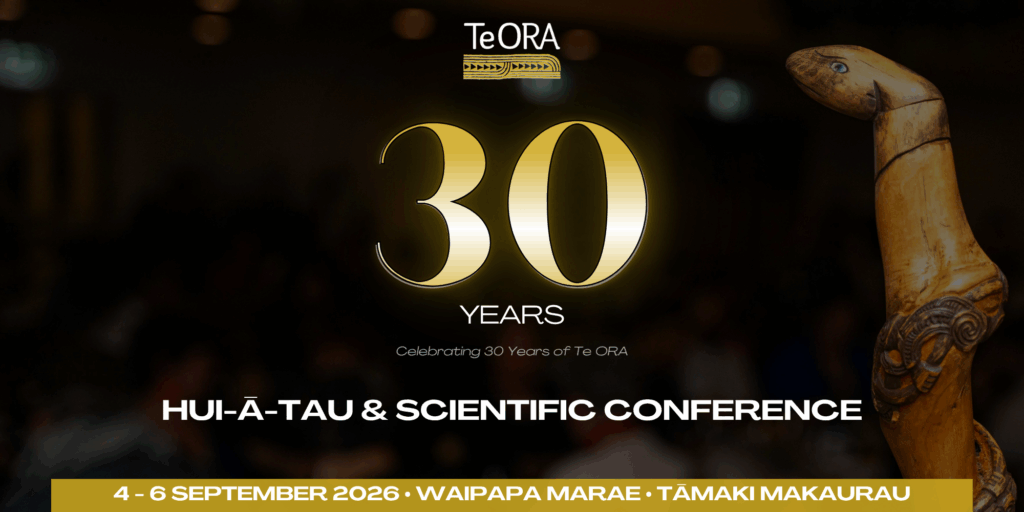
Titiro whakamuri, kōkiri whakamua
Look back and reflect, so we can move forward.
As Te ORA gathers for Hui-ā-Tau 2026, we do so in recognition of the long and enduring whakapapa of Māori medical leadership, advocacy and collective action, and of Te ORA’s role over the past 30 years in carrying that kaupapa forward. This year’s theme, Titiro whakamuri, kōkiri whakamua — Look back and reflect, so you can move forward, invites us to honour those who have paved the way, reflect on the progress and challenges that have shaped our profession, and look forward to the future of hauora Māori with purpose and hope.
The Scientific Conference provides a space for Māori doctors, medical students, researchers, clinicians, health leaders and allies to share knowledge, research, innovation, clinical experience and whakaaro that contribute to better outcomes for whānau Māori. We particularly welcome abstracts that connect past, present and future: acknowledging the foundations laid by earlier Māori medical practitioners, examining the realities facing Māori communities and the health workforce today, and offering practical, transformative pathways forward.
Abstracts may address a broad range of topics relevant to Māori health and the Māori medical workforce, including but not limited to: hauora Māori, clinical practice, kaupapa Māori research, health equity, Māori medical education, workforce development, advocacy, whānau-centred care, innovation, leadership, community health, public health, and reflections on the role of Te ORA over the past 30 years.
Accepted abstracts may be offered as either oral presentations or poster presentations. Authors may indicate a preferred presentation format when submitting, however the final presentation format will be determined by the Scientific Committee based on the abstract, programme fit and available presentation spaces.
The Call for Abstracts closes at 12:00pm, Friday July 17. Abstracts will be reviewed by the Scientific Committee, and authors will be notified of the outcome by July 31.
Oral Presentations
Oral presentations will be approximately 20 minutes, with time for discussion. Exact presentation times will be confirmed with successful applicants.
Standard audio-visual equipment will be available, including a data projector with sound, lectern and microphone. OHP and slide projectors will not be provided.
Poster Presentations
Successful poster presenters will be required to:
- prepare an A0 poster in portrait orientation;
- arrange for their own printing to ensure the quality of their work;
- bring their printed poster to Hui-ā-Tau;
- display their poster in the space allocated by Te ORA; and
- be available at times during the programme to discuss their poster with attendees.
Selection Criteria
Abstracts will be assessed by the Scientific Committee against the following criteria:
- Relevance to the conference theme
- Importance and clarity of the presentation topic
- Relevance of the content to the Hui-ā-Tau audience and to Te ORA
- Contribution to Māori health, Māori medical leadership, research, education, clinical practice, advocacy or workforce development
- Abstracts submitted by Māori doctors and medical students will be prioritised
- Presentations may be delivered in te reo Māori and/or te reo Pākehā
Abstract Guidelines
The Call for Abstracts closes at 12:00pm, Friday July 17. Abstracts will be reviewed by the Scientific Committee, and authors will be notified of the outcome by July 31.
Please note the following requirements:
- Please complete the abstract submission form
- Abstracts must be no longer than 350 words, excluding title and biography.
- Abstracts may be submitted in te reo Māori and/or te reo Pākehā.
- A short biography of the author/s, including affiliations, must be included and must be no longer than 100 words.
- The abstract should include text only.
- References may be included but are not required.
- Medical students submitting abstracts are required to include a senior clinician, academic or research supervisor where appropriate. It is important for us to foster a safe environment for all presenters.
- The Scientific Committee may contact authors to clarify the nature or scope of the intended presentation.